

Transforming Forest Management with Technology
What does Precision Forestry look like to foresters and researchers in New Zealand? The Precision Silviculture Programme is a 7-year initiative aiming to turn vision into reality. Supported by industry and government, the goal is to digitise, mechanise, and automate forest management tasks from nursery through to the final thinning of the forest. In New Zealand, advancements have been made in harvesting, but silviculture activities have remained largely unchanged for over 60 years. We still lift bare-root stock from nurseries by hand, plant ~70,000 seedlings and cuttings annually with a spade, prune with shears, and thin largely with chainsaws. While inventory management has progressed with the use of drones and large data sets, there is immense potential for new technologies and insights from interconnected data.
Revolutionising Nursery Practices with Technology
The Precision Silviculture Programme aims to enable technology use in nurseries with a digital record of planting stock that tracks movement from the nursery to the field. This will be facilitated through a new app called PlantIT. Using QR codes, nursery workers can label boxes, bags, or pallets to provide precise GPS locations that track boxes of stock ready to be planted. Geolocation helps with traceability, ensuring growers know when stock is on route and where they are planted, also supporting biosecurity tracking in case of an incursion. Truck drivers scan these labels at pallet level, creating a time and location stamp. When planting stock reach the planting site, the app tracks their arrival and time of planting. This also simplifies retrieving empty boxes for reuse, saving money. The timestamp allows nurseries and forest companies to track when trees were delivered versus when they were planted, crucial for assessing tree quality and subsequent survival. PlantIT also allows uploading of photos of damaged trees for clear evidence in discussions about stock quality with nursery managers. The app has the potential to integrate with mechanical planting systems or GPS-enabled spades for precise identification of tree locations, further enhancing traceability from nursery to forest. PlantIT will be available for commercial use in 2025. In the nursery space, projects are also underway to mechanise lifting of planting stock in bareroot nurseries, automate the task of monitoring stock in both containerised and bareroot nurseries and streamline and optimise practice for de-plugging, grading and packing.
Exploring Individual Tree Data (ITD)
Historically, the forest industry in New Zealand captured forest information at a stand or compartment level, using population sampling and averages. This data collection was labour-intensive, involving physical measurements at certain times throughout the forest life cycle. Recently, there has been a shift to using spatial information to represent forest crops. New and emerging technologies now allow forest managers to capture location and tree-demographic data at the individual tree level from planting to harvest, crucial for unlocking more precision practices. For example, precision herbicide spraying can reduce chemical use, lower labour needs, and increase safety. The Precision Silviculture Programme has been exploring the value of ITD to forestry. We’ve consulted the industry to gauge their understanding of ITD, its technology, and the barriers to adopting these technologies. Participants saw ITD as transformative for the forest industry within New Zealand but wanted further demonstration of successful ITD capture projects to encourage adoption. Examples of ITD capture include remote sensing and/or aerial imaging technologies that allow for the capture of individual tree location, health, and tree demographics data soon after planting.
Supporting Innovative Technologies
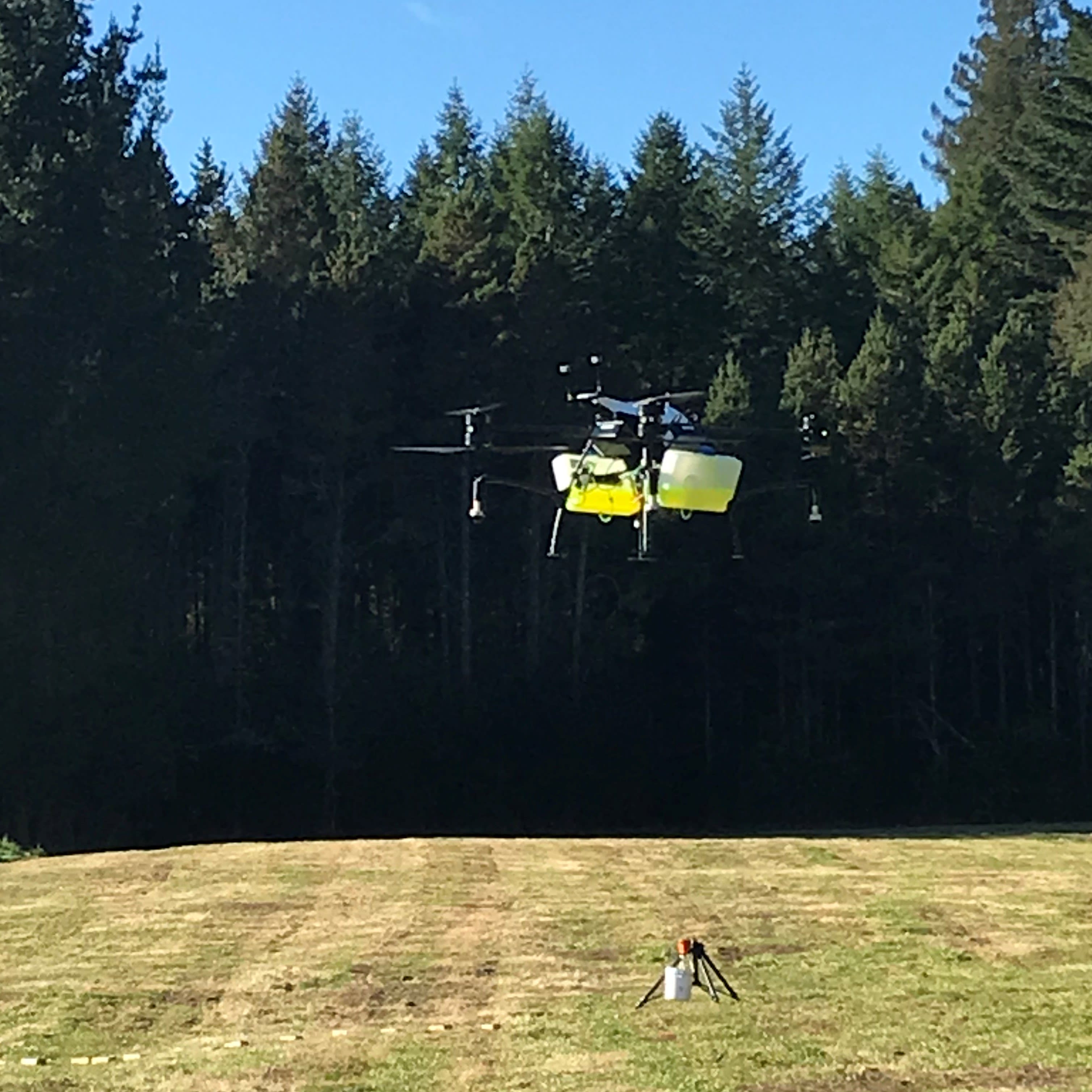
A good example of a use case for ITD is precision spot spraying. The Precision Silviculture Programme is supporting a New Zealand based company SPS Automation in developing a precision spot spraying drone for forestry. The drone can deliver a precision dose of chemical spray to an individual tree target and adjust the dosage according to the scale of the issue. It has an embedded reporting system that shows chemical distribution and rates spatially post-operation. This prototype aims for continuous flight, carrying a 50 kg payload and a flight time of 120 minutes. Field testing of the first prototype is planned for winter 2025.
On a micro scale, the Programme is supporting the development of GPS planting spades to obtain individual tree locations at the time of planting. On a macro scale, more complex machinery is being evaluated and adapted to fit the New Zealand market and forestry conditions. The assessment of mechanised planting machines includes the M Planter and PlantMax, with plans to evaluate the Risutec in 2025.
Digitising Forest System Design
Tools to support more precise thinning operations and digitising forest system design are in development. TreeTools is a new online tool funded by the Programme that uses drone technology to make post-thinning stocking assessments faster, more accurate, and easier to implement. Users can capture high-quality aerial images by flying a drone over forestry operations. These images are processed to create a virtual set of forest inventory plots and summaries, providing fast and effective stocking estimates.
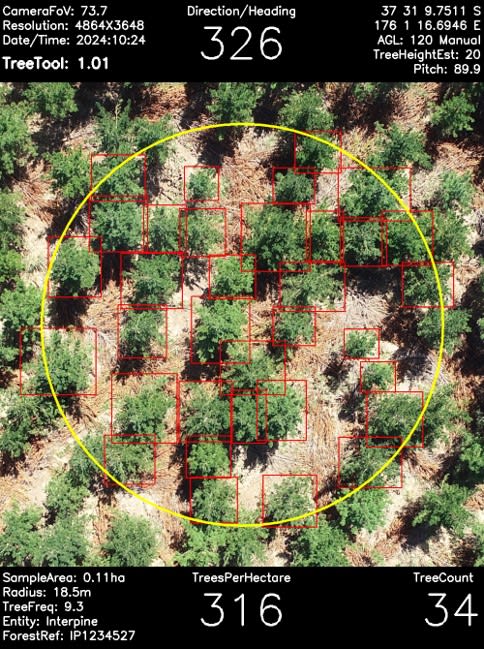
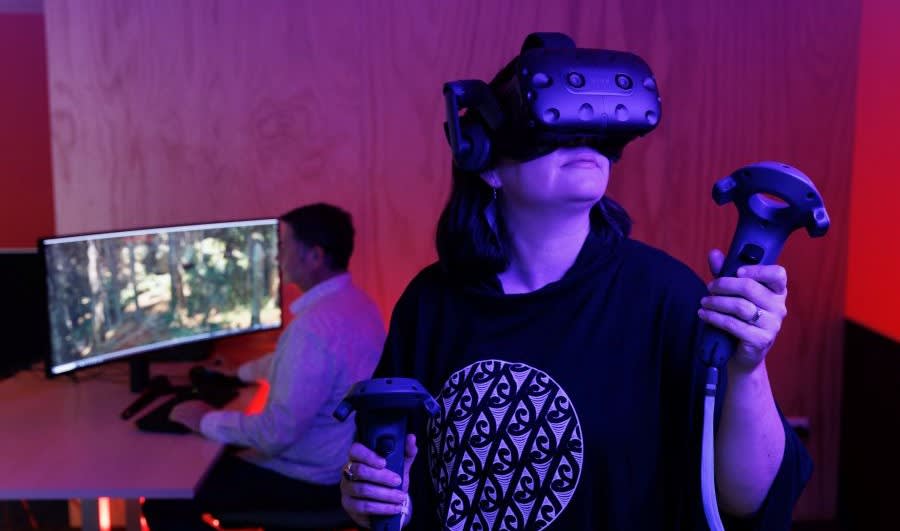
The user-friendly interface ensures the process is intuitive and easy to use in the field. Results can be uploaded to applications like Avenza Maps for immediate feedback and review by contractors. Drones can be used in the field and images processed in near real time allowing forest managers to collect virtual plots with ease and efficiency. Stocking assessments generated by drones rely on factors such as accurate canopy recognition and consistent drone altitude maintenance. Under normal conditions, the goal is to maintain a stocking error below 10%. User corrections can also be made to refine assessments when necessary Click here to findout more The Programme is also supporting the Crown Research Institute Scion (New Zealand Forest Research Ltd) in the development of a Virtual Reality module for training new recruits on thinning operations View more here
Concepts for Low Impact Multi-Use Machinery
Low impact multi-use machinery is in concept development for thinning to allow for greater social license and safe operation when operating on steep slopes including teleoperation and with the ability to tether. Development of attachments able to do more with a single machine, such as integrating pruning and thinning is ongoing. This is just a snapshot of what is underway in this exciting programme. With over 30 live projects, if anything caught your attention and you would like to learn more visit our website below or connect on LinkedIn.
You can find more information on our website: Precision Silviculture Programme
Follow us for the latest updates on our LinkedIn Group: Linkedin