

Insights from Horticulture
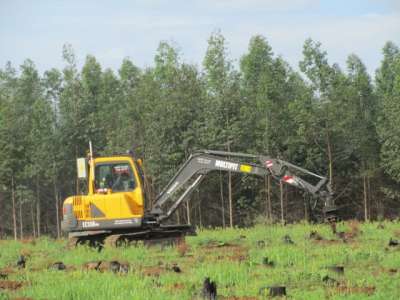
When managing a forestry nursery, financial performance often takes center stage, with key performance indicators (KPIs) such as net margin per seedling driving many decisions. This metric, calculated as the revenue minus costs per shipped seedling, is a critical focus for both independent nurseries and vertically integrated multinational companies striving for financial health. However, it’s worth questioning whether this KPI fully captures the true value of a nursery's operations. If we shift the focus to the core function of a nursery, we might argue that the primary purpose is to deliver healthy, strong, and uniform seedlings at a competitive price. Imagine if the success of a nursery was measured by the survival rate and quality of the trees in the plantation rather than just the immediate financials. After all, the market value of a seedling is minimal compared to the value of a seven-year-old tree. In this context, the cost of producing a seedling becomes secondary to its quality. Every subpar seedling leaving the nursery can significantly impact the operational margin of the plantation forest—perhaps only 4-5% of the stand, but in absolute terms, this represents a substantial loss.
Embracing Automation for Improved Profitability and Efficiency
To achieve a paradigm shift where profits are enhanced while reducing inputs such as water, energy, and labor, automation could be the key driver. By automating processes, nursery managers can not only reduce costs but also improve the quality and volume of their output simultaneously.
Where to Begin?
Start by identifying the most labor-intensive processes and the growing stages with the highest waste rates. Typically, this spotlight will fall on cutting planting, rooting, and seedling grading. For instance, it’s common for about one-third of harvested cuttings to go to waste. In a nursery producing 100 million seedlings, this translates to over 30 million cuttings wasted, rendering tens of thousands of mother plants obsolete. The sooner waste can be reduced, and quality improved in the process, the greater the impact on profits.
Let’s take a closer look at cutting planting, where automation could provide a quick win. Two key issues to resolve with robotics are:
1. Planting Depth: Inconsistent planting depth can lead to uneven rooting success, with cuttings planted too deep or too shallow eventually resulting in waste. Variations in depth can cause a heterogeneous crop.
2. Rooting Issues: Poor rooting due to non-centered planting results in uneven root distribution, leading to plug disintegration and difficulties in field planting.
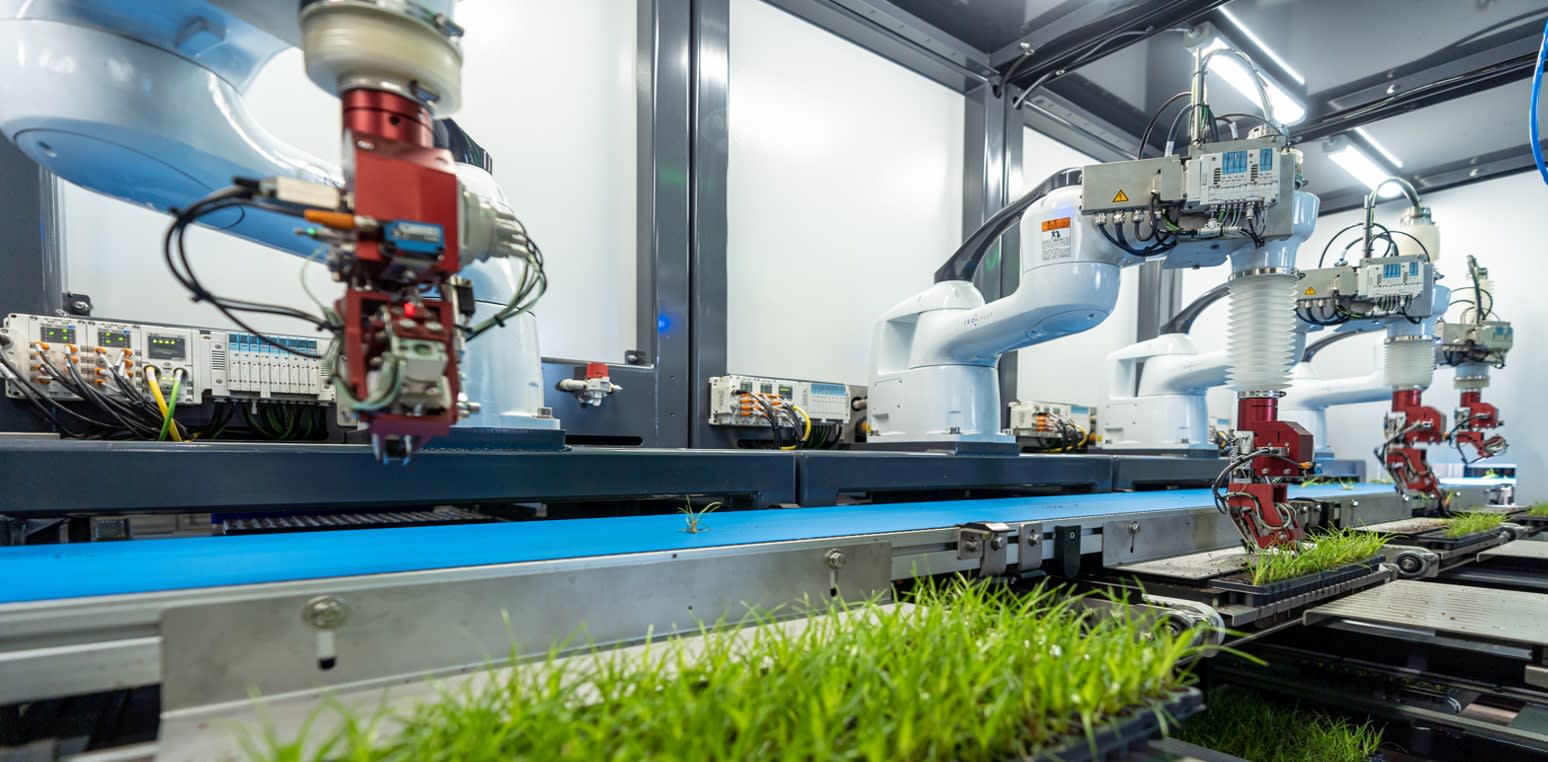
By automating these processes, nurseries can ensure consistent planting depth and centricity. A robot’s ability to repeat every movement uniformly, day after day, makes this possible. Adjustments like cutting length or curvature become mere software settings, making the process efficient and reliable.
Learning from Other Industries
In many sectors, robotics are as common as chainsaws in forestry. Horticulture, particularly mid and high-tech greenhouses, offers valuable insights. Decades ago, growers began micro-managing costs, often driven by competition, government regulations, or labor shortages. They focused on increasing output at lower costs while maintaining, or even improving, product quality—a seemingly contradictory goal that Dutch growers have mastered, leading them to the forefront of greenhouse efficiency.
Innovative Solutions from Greenhouses
In the early days of greenhouse farming, paths were necessary to tend to crops, leading to inefficient use of space. Over time, greenhouses evolved, and today, many have eliminated manual work entirely. Plants now move on rolling containers from start to finish, with containers moved out of the greenhouse for intermediate work by either workers or robots. This maximizes the use of expensive, climate-controlled space, resulting in lower costs per seedling. Interestingly, this system also increases the greenhouse's capacity beyond its physical space due to the continuous internal logistics of moving plants.
Planting Cuttings: The Chrysanthemum Example
Consider the chrysanthemum, a crop that sees an enormous volume of cuttings planted annually. In East Africa, billions of cuttings are harvested and shipped to Dutch growers, where robots plant them into plugs for rooting. The speed and consistency of this automated process reduce labor costs and enhance quality and profits. For many Dutch growers, the return on investment in automation can be realized in just a few months. The strong economic case for automation has also been seen in tulip bulb planting, where nearly 100% of growers have invested in automation within three years, despite using the machines for only three weeks per year during the planting window.
What’s Next for Forestry Nurseries?
It’s time to open your mind to a paradigm shift. By learning from other industries, like horticulture, you can bring innovative practices and technologies into your nursery operations for quick gains. However, remember that automation isn’t a silver bullet. It’s not perfect, just as manual labor isn’t. But unlike human workers, robots don’t need breaks. When considering automation, don’t just focus on automating a single manual task—take a holistic view of your entire process and its intermediate steps. Automating one step might resolve issues in other steps or even make some steps obsolete. For a tailored solution, consider consulting with experts like ISO, who can help you find the best approach for your specific operation.
For more information visit isohorti.com