

Background
The Nelson Mandela University forestry department had the opportunity to host the 6th Modern Silviculture Webinar under the theme “Digitisation in Modern Silviculture”. The webinar provided a platform for local and international experts, researchers, foresters, managers, and students to share knowledge through presentations and discussions on modern silviculture technologies in silviculture operations. This event was sponsored by IUFRO Division 3 and Novelquip Forestry. The proceedings were held live on Teams on the 15th of October 2025. The webinar was attended by 430 people from 32 countries. Participants included researchers, academics, and students (46%), foresters and managers (44%), as well as contractors, consultants, and machine manufacturers (10%). A summary of all the presentations is provided below.
Precision Silviculture Initiatives and Progress in New Zealand
Ms Claire Stewart presented on “Precision Silviculture Initiatives and Progress in New Zealand.” She introduced New Zealand’s forestry landscape, where Pinus radiata dominates 85% of the country’s plantation area. She outlined the national Precision Silviculture Programme, a seven-year initiative jointly funded by industry (60%) and government (40%) to modernise nursery-to-field operations. The programme integrates nursery propagation, planting, pruning, thinning, and data systems research. Key innovations include the BioScout airborne pathogen-detection tool using AI and weather data for early disease warning, microsensor platforms for mapping greenhouse microclimates, and drone-based real-time seedling performance tracking. Stewart also highlighted mechanised and semi-mechanised planting trials, such as the PlantmaX and Risutec planting equipment adapted for steep terrain. Additional research focuses on precision spraying with the BFD-70 heavy-lift forestry drone and developing robotic and excavator-mounted pruning systems. The programme further explores digital twins, virtual-reality thinning simulators, and UAV/LiDAR-based stand assessments to model and test future mechanisation scenarios. Stewart concluded that precision silviculture research in New Zealand is rapidly advancing toward data-driven, adaptive, and technology-enabled plantation management.
Perspectives on Silviculture Digitalisation in South Africa
Mr Thembinkosi Zulu presented on “Perspectives on Silviculture Digitalisation in South Africa.” Drawing from his ongoing MSc research, his presentation explored how digital tools are adopted within South African silviculture operations and how stakeholders perceive the digital transformation process. The study involved 23 industry professionals across four provinces (Mpumalanga, KwaZulu-Natal, Eastern Cape and Western Cape), including growers, contractors, and technology developers. It assessed digital maturity, drivers, barriers, and opportunities for inclusive adoption. Results showed that while harvesting operations in South Africa have digitalised to some extent through telematics, silviculture remains largely manual, with 48% of organisations at a low digital maturity level and only 17% at a high level. Commonly used tools include instant messaging (e.g., WhatsApp), administrative software (e.g., Microsoft Excel), and applications using spatial data (e.g., GIS mapping). At the same time, advanced systems such as telematics and real-time data platforms remain rare. Key drivers include efficiency, competitiveness, and compliance with sustainability standards, whereas barriers include technical constraints, limited digital skills, and high costs. Zulu highlighted the uneven distribution of digitalisation benefits, with large growers and managers benefiting most, and called for a national digitalisation strategy, improved rural connectivity, and inclusive training. He concluded that South African silviculture is in the early stages of digital transformation, with significant potential if efforts focus on integration, inclusion, and practicality.
Mulchers as an effective tool for residue and fuel load management
Mr Deon Redinger from Saviti presented on “Mulchers as an effective tool for residue and fuel load management”. His presentation covered the role of mulching in forestry, focusing on its benefits for reducing fuel loads and improving site management. He explained the differences between wheeled and tracked mulchers and outlined the operational reasons why wheeled mulchers are often preferred. He also discussed the practical applications of mulchers in the field, including clearing material between timber stacks, processing old stumps, opening compartments, and preparing extraction lines to facilitate easier access for machinery. He described how mulching performance and outcomes vary across species such as pine, eucalyptus, and wattle, highlighting both their advantages and limitations. This discussion led to the use of mulching to establish firebreaks. He then addressed operational challenges and considerations, including mulching on steep slopes, working under dry or drought conditions, and the risk of stones interfering with the mulching teeth and causing wear or damage. Finally, he touched on under-canopy mulching using a tractor-mounted mulching head and integrating a modified mist blower for post-mulching weed control, particularly in buffer zones.
A Single-Head Planting Solution for South African Conditions
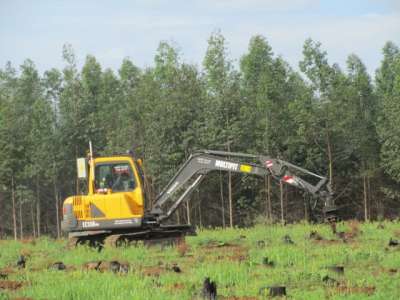
Mr Stephanus Viljoen from Novelquip Forestry presented on “A single-head planting solution for South African conditions”. He began his presentation with Novelquip’s providing an overview of the latest results from field trials (since 2023) of the Ponsse forwarder-based four-head planter currently being tested in South America. Thereafter, he highlighted the drivers and challenges to mechanised silviculture in South Africa, specifically the need for locally adapted solutions. He then introduced Novelquip’s latest innovation, ProPlant 1, a single-head excavator-based planting machine. Early results reveal productivity of 120 plants/hr, and in partnership with strategic partners, the machine will undergo field testing in Q1 2026, with the commercial models available in Q3/4 of 2026. He invited partners to develop efficient silviculture systems adapted to their unique conditions.
Smart Traceability for Forestry Nurseries: The Role and Integration of Ellepot Live
Mr Darran Stone from Ellepot presented on “Smart traceability in forestry nurseries: The role and integration of Ellepot Live”. His presentation highlighted key challenges currently facing the forestry and nursery sectors, including reliance on manual tracking and paper-based processes, the slow pace of digitalisation, limited skills transfer and retention, rising production demand, and a shrinking pool of skilled workers. He explained that Ellepot Live is a digital production management platform that provides machine-connected production data, real-time performance monitoring, and predictive maintenance insights. This led to a discussion of GROW SMART, which he described as a central intelligence hub for nursery management. The tool serves as the “living memory” of the nursery, integrating information on soils, substrates, trays, and batch history, while enabling remote access to all critical production data. He elaborated on additional digital features supporting operational efficiency, including traceability and quality control systems, substrate mix optimisation, asset tracking and tray management, resource planning and utilisation, and live production dashboards. In closing, he addressed future-proofing strategies anticipating the AI revolution, particularly emphasising the importance of bridging nursery and field-level data to link batch performance to field outcomes, fostering partnerships, and securing grower support.
Using Advanced Mapping Tools to Improve Silviculture Operations Management
Mr Harley Schinagl from TerraLab (Australia) presented on “Using Advanced Mapping Tools to Improve Silviculture Operations Management”. He started his presentation by noting the significance of manual workers in modernised silviculture operations. He then introduced the STA logger application and devices, which are land-management tracking tools used in manual spraying and planting operations. Thereafter, he explained that these devices are autonomous, do not require Bluetooth, an app, or setup, and begin capturing and storing data as work begins. Once attached to the tool (knapsack or planting tube), the sensors are activated once movement starts. Thereafter, he gave an overview of case studies in Canada, Uruguay, New Zealand, Australia, and the USA on the applicability of the technology in mapping manual spraying (site preparation), traceability in planting, and tree density from weed spraying. This data can be used to map, track, and monitor operator workflows to improve the efficiency of silviculture operations.
Application of Drones for Stand Monitoring and Survival Assessment After Regeneration
Ms Beatriz Zerbinato Balista presented on “Application of drones for stand monitoring and survival assessment after regeneration.” Her presentation highlighted a proof-of-concept (POC) study conducted in partnership with UNESP to improve seedling survival monitoring using drones and artificial intelligence. She began by contextualising Brazil’s forestry sector, noting its global leadership in Eucalyptus productivity—over 10.5 million hectares of planted forests — and its challenges, such as high labour costs and the time-consuming nature of manual survival assessments. The project aimed to replace manual early survival assessments with drone-based detection and automated mapping to guide replanting decisions. Between 2023 and 2025, the POC tested different sensors (RGB, multispectral, and LiDAR) across five forestry companies and 14 plots, each covering 30 hectares, in São Paulo, Mato Grosso do Sul, and Minas Gerais. Results showed that the multispectral MicaSense sensor achieved the highest accuracy (up to 99%) in distinguishing live from dead seedlings, particularly on clean, recently established sites. In 2024, seedlings were successfully detected as early as 15 days after planting with 94–97% accuracy. By 2025, the team had developed and validated a mobile application to visualise mortality “heat maps” and identify precise replanting zones. Using GPS-guided navigation tools such as smartwatches or tablets, workers could replant only in necessary areas, reducing replanting time by 28% and walking distance by 35%. The system also enabled selective replanting based on mortality thresholds, improving cost-efficiency and planning accuracy. The project achieved significant advances, including defining optimal flight parameters, developing high-accuracy mortality maps, and validating large-scale field applications. Ms Balista concluded that drone- and AI-based monitoring substantially enhances operational efficiency, reduces costs, and supports precision replanting across Brazil’s industrial forestry sector.