

1. TECHNOLOGY PROGRESSION IN BRAZIL
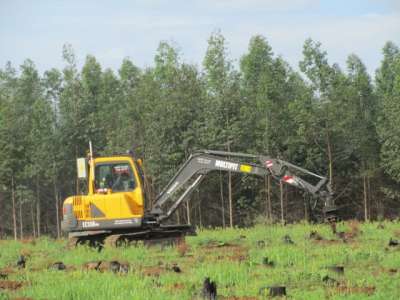
In Brazil, several decades ago, practices associated with the establishment of commercial forests were predominantly manual, lacking genetic improvement and advanced technologies. This reality, which is far from current practices, has evolved significantly in recent years, and today the country is a global reference in planted forests, being a pioneer in several technological advances and innovations in forestry practices. This achievement is due both to favorable edaphoclimatic conditions and to incentives and the constant search for disruptive innovations, especially driven by the private sector. While we have not yet reached the peak, the speed to reach new levels of quality, productivity, and excellence in forest production is increasing every day. We are living in an era of growing mechanization, automation, and autonomy in our operations. These advances have allowed Brazil to become a global reference, not only for large-scale production but also for incorporating sustainable practices, focusing on reducing environmental impacts and improving operational safety.
Ingredients of a digitized forest
According to a study by IPEF (GUERRA et al., 2023), the overall level of mechanization in soil preparation, planting, fertilization, weed control, pest control, and sprouting control operations is only 44.58%. A large part of the operations is still manual or semi-mechanized, representing 47.5% and 6.94%, respectively. Only 0.97% of the operations are automatic, meaning they are controlled by artificial systems with a high degree of technology and low human intervention. Aiming for a future digitalized forest, with more autonomous operations and processes, there is a significant challenge to overcome, which starts with the need to increase the level of mechanization. This advancement should be followed by the implementation of embedded systems (sensors and actuators) for the automatic triggering of certain activities, progressing to the automation of operations with low human intervention and greater optimization of actions and resources, driven by artificial intelligence, predictive analytics, optimization models, among other technologies.
Drivers of advanced productivity management systems
Several years ago, the initial use of embedded technology in forestry mechanized operations was primarily motivated by the heterogeneity in the application of fertilizers, which directly influenced the uneven growth of trees, impacting forest productivity as well as subsequent operations such as logging (harvesting). The initial solution aimed at controlling the application of inputs, adjusting the flow rate according to the variation in the machine's speed, thus ensuring the proper dosage per covered area. As challenges were overcome, new challenges arose, requiring the development and offering of increasingly technological, automated, and optimized solutions. One of these challenges was the need for better management of the productivity of work fronts and increased operational efficiency.
2. IMPROVEMENT IN OPERATIONAL EFFICIENCY
Due to sensing, georeferencing, and monitoring of machines and implements for precise input application, new functionalities have been incorporated into embedded technology to automatically point out productive and non-productive activities. Real-time monitoring of the operation status and the visualization of this information in a control room lead to significant gains in decision-making speed by the manager. Reliable reports from automated pointing offer great potential for management, future activity planning, negotiations, and bonuses for third parties and employees, based on data such as productive times or downtime by machine, operator, work front, service providers, regions, among others.
"Gamification" - monitoring performance with precision
Hexagon has implemented a functionality known as "Gamification" in various clients, allowing the operator to monitor their performance based on benchmark indicators provided by the supervisor. These indicators are customized according to the specifications and characteristics of the operation and area, serving as an incentive for meeting daily goals, aligned with bonus programs, which leads to excellent results for both the company and the employee. Additionally, the manager can track performance in the control room, enabling faster, more assertive, and efficient decisions.
Another functionality aimed at improving operational efficiency, integrated into the embedded technologies in mechanized operations, is monitoring idle engine time. Depending on the operation, machine model, and power, as well as the workflow, the embedded system can detect when the engine is idle and alert the operator to act, reducing idle engine time, excessive fuel consumption, and, consequently, operational costs. In a project aimed at determining idle engine time during base fertilization operations, a 9.4% reduction in the total time of the analyzed period was observed through educational alarms for the operator. Considering a fleet of 10 machines working an average of 8 hours per day for 21 days a month, totaling 1,680 hours per month, it was observed that 158 hours were spent with idle engines. Considering a consumption of 1.5 L/h at idle, it is estimated that this would save 237 liters of fuel per month.
The use of embedded precision technology allows for numerous possibilities for managing performance and production in operations. One example is the insertion of maps of the areas to be worked on, along with recommendations for the amount to be applied in each area, which brings several gains to the operation. One of these gains is optimizing performance by reducing maneuvers between blocks. The operator can perform the task in continuous shots between areas, with the system automatically suspending the application when crossing a road and resuming it when entering the other area, adjusting the amount applied according to the recommended dosage. The video below illustrates the Centralised control system that monitors operations in real-time: HxGN AgrOn Control Room.
Best sustainable practices
In addition to efficiency gains, the incorporation of embedded technologies also reflects more sustainable practices. By using the map with the limits of productive areas on the display installed on the machines, the operator has a visual and audible tool to help respect the planting area boundaries, thus reducing the risks of encroaching on natural environmental protection areas. Hexagon offers the "Electronic Fence" functionality in embedded technology solutions for control and monitoring. This contributes to reducing penalties imposed by government agencies. In case of incidents, managers' ability to verify and understand the potential impacts allows for better problem assessment and contributes to the planning and implementation of mitigation actions. Due to the rich and extensive database and the monitored machine and implement information, georeferenced operation reports can become a valuable tool for environmental inspections and audits, proving compliance with environmental regulations.
Embedded technology in mechanized operations minimizes environmental impact through the conscious and proper use of inputs, including non-renewables, while also reducing the carbon footprint through functionalities that decrease fuel consumption and idle engine time, as well as other resources that generate CO2 in the production and transportation processes. On the other hand, the same technology can contribute to greater coverage of planted areas in productive zones through tools that ensure alignment and total coverage, resulting in more trees planted and consequently higher carbon sequestration.
Best practices in operator safety
Embedded technologies not only contribute to operational efficiency but also promote operator safety, minimizing risks during the execution of activities. A significant functionality currently in high demand by forestry companies operating in more sloped areas is the slope alert. This solution can be integrated into the embedded technology for monitoring and controlling mechanized operations, generating a visual and audible alert that indicates in real-time when the lateral or front slope of the machine requires attention or reaches critical levels. This is an essential solution for capturing the micro-relief of the area. Another alternative is the insertion of the slope map of the areas, which signals risky zones to limit operator access. In addition to the immediate action with the operator, georeferenced slope data is also collected, processed, and can be viewed in reports in the control room by the manager, as well as used for adjustments to the company's georeferenced database.
Safety alert tools focused on operator well-being can be integrated into existing technologies in operations, such as alerts for exceeding maximum speed limits, work shift management, control of the maximum allowable overtime, and authorization for operating only authorized vehicles, among others. These tools not only ensure operator safety but also prevent non-compliance by providing managers with real-time access to information in the control room, enabling prompt actions as soon as an alert is generated.
Other features, primarily focused on prevention, can also be integrated into embedded technologies. Hexagon has developed several functionalities for this purpose, one of which is the "Checklist," where the operator answers a series of questions regarding the machine, implement, input, and operating conditions. Once filled out, the manager or maintenance analyst can access the data in the control room and take the necessary actions if needed. In this way, whenever there is an observation that requires maintenance and poses greater risks to the operator until corrected, the maintenance team receives priority attention.
3. WHERE ARE WE GOING?
The increasing mechanization and automation of forestry operations, along with the implementation of precision technologies, not only boosts productivity but also promotes a more sustainable and safe production, with positioning companies at the forefront of innovation in the sector. We are rapidly advancing toward a digitalized forest with autonomous operations that optimize resource consumption in a precise manner. With the significant advances observed in the past decade, and considering the continuous technological evolution and the relentless search for innovation in the sector, digital transformation will accelerate, becoming more agile and disruptive.
GUERRA, S. P. S.; OGURI, G.; SCHUMACHER, M. V.; KULMANN, M. S. de S.; FARIA, J. I. Levantamento do nível de mecanização na silvicultura: edição 2022/2023. Instituto de Pesquisas e Estudos Florestais (IPEF). Piracicaba, 2023. Disponível em: PUBLICAÇÃO2.cdr. Acesso em: 5 nov. 2024.
Information for this article provided by Claudia Wesselka Garcia (Forestry Contract Manager Autonomy & Positioning division - LinkedIn Claudia Wesselka Garcia)
For more information visit Hexagon.com