

Background
Fire protection activities, such as firebreaks, are critical to commercial forestry, helping protect plantation assets, infrastructure, surrounding communities, and the long-term sustainability of forestry operations. Fires can cause extensive damage to plantations, resulting in significant financial losses. Preparing and maintaining firebreaks can require considerable labour, particularly where vegetation is dense and regrows rapidly. Forest managers commonly use fire (e.g., under canopy burning) or disking to reduce fuel load. However, vegetation management can also be done mechanically with an FAE RCM/SSL rotary cutter.
About the machine
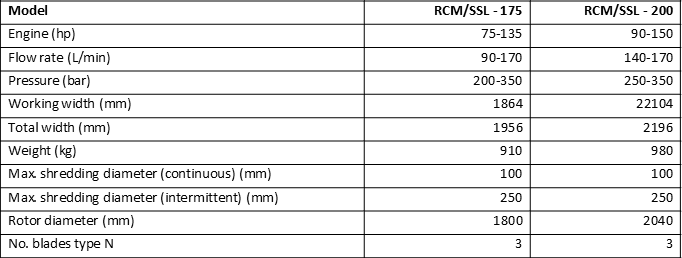
The FAE RCM/SSL rotary cutter is a hydraulically driven attachment designed for skid-steer loaders and intended primarily for removing dense brush, shrubs, and small trees. According to FAE, the attachment is compatible with skid steers in the 75–150 hp (55 – 110 kW) range and is designed for applications where rapid vegetation processing is a priority. Its potential relevance to forestry lies in vegetation clearing and maintenance activities, including work associated with preparing or maintaining firebreaks. The cutter features a direct-drive motor, a compact design intended to support manoeuvrability, a push frame, and wear-resistant Hardox skids. Its cutting system uses type-N blades, while tungsten-carbide-toothed protective plates help protect the underside of the disc. These design features are intended to support vegetation-processing operations in appropriate working conditions. FAE specifies a continuous shredding diameter of approximately 10 cm, with larger material up to approximately 25 cm handled intermittently, depending on operating conditions. These figures reflect the manufacturer's stated cutting capacity; actual performance depends on vegetation characteristics, machine compatibility, and site conditions.
Potential application in forestry
The RCM/SSL may be worth considering where dense brush and smaller woody vegetation need to be cleared within the stand, along designated firebreaks, or in other forestry maintenance areas. The attachment's suitability will depend on the required fuel management requirements, vegetation density, terrain, access, operating costs, and the capabilities of the carrier machine. Before adopting this type of equipment, operators should assess its productivity, fuel consumption, maintenance requirements, and cost per hectare under local operating conditions. Comparing these measures with existing vegetation-clearing methods would help determine whether the technology offers practical and economic benefits. It is also important to recognise that simply cutting vegetation does not automatically produce an effective firebreak. The effectiveness of resulting material, fire risks and behaviour, as well as ground conditions and remaining combustible vegetation, must be considered. Firebreaks need to be planned and maintained so that they serve their intended purpose without creating erosion or other environmental impacts.
For more information, please visit: RCM/SSL | FAE USA