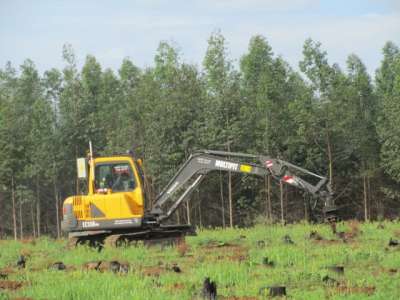


Forestry plantations play a vital role in supplying timber, pulp, paper, and other forest-based products. The success of a forest plantation largely depends on the quality of seedlings planted in the field. Typically, high-quality seedlings exhibit better survival rates, faster growth, and greater resistance to environmental stresses such as drought, pests, and diseases. For this reason, seedling grading is a crucial process in forest nurseries before seedlings are distributed for planting. Traditionally, seedling grading is performed manually by nursery workers through visual inspection, followed by sorting seedlings based on characteristics such as height, stem diameter, leaf condition, and overall plant health. This method of grading presents several challenges, as it is time-consuming, labour-intensive, and prone to human error and inconsistency when processing large numbers of seedlings. Advances in artificial intelligence and computer technologies have created new opportunities to enhance the efficiency and accuracy of seedling grading in forestry nurseries. These tools can analyse images of seedlings captured by cameras, automatically measure key growth parameters such as plant height, leaf area, and colour, and then classify them into different quality grades. Furthermore, rapid plant quality (RPQ) can be done where automated measurements of plant heights with a tray in the nursery are taken using a phone camera and Python scripting. The data obtained can provide information to develop growth curves and assist with the automated measurement of plant quality. Multispectral sensors can be used to identify problem areas, and thermal imaging can be used to check the stress level that is experienced by the plants in a nursery tray.
How AI is used in seedling grading
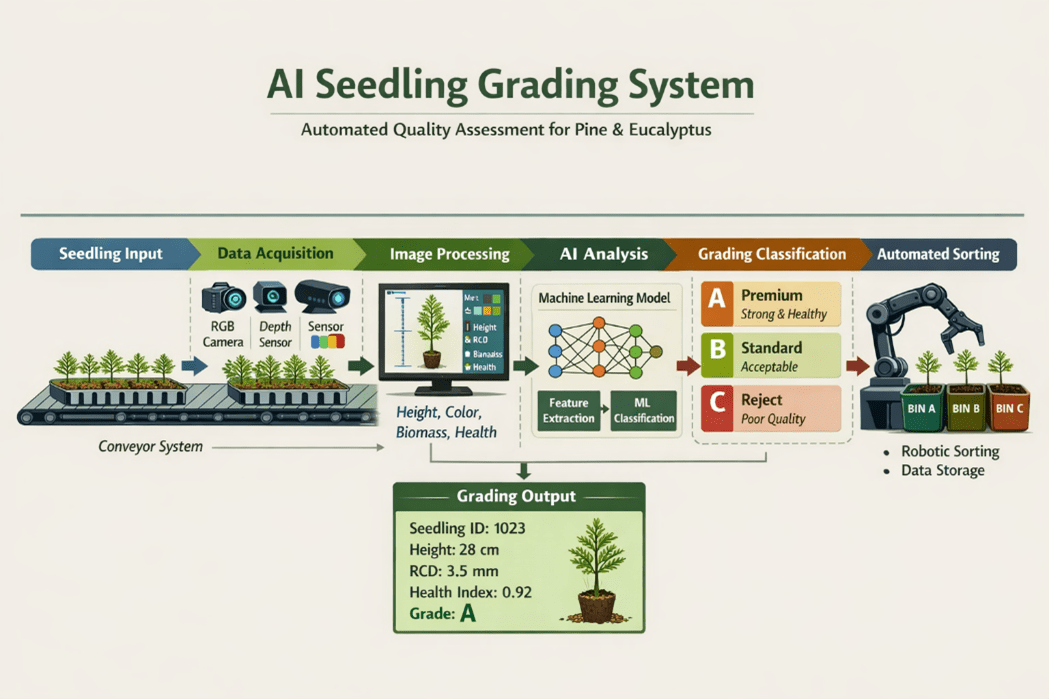
Artificial intelligence is used to grade seedlings using sensors, computer vision systems and machine learning algorithms. Cameras can be used in nurseries to capture images of individual plants. These images can then be analysed by AI software that identifies the seedling and evaluates specific physical characteristics such as height, root collar diameter, leaf colour, and plant structure. These are important indicators of seedling health and growth potential. Each plant is compared to the required plant quality specifications. After analysis, the system can automatically classify seedlings into different quality grades (high, medium, or reject). This can be integrated with automated sorting machinery that, after seedling image analysis, uses robotic arms to separate seedlings into different grade groups.
Benefits of AI seedling grading
• AI systems can process large numbers of seedlings within a short period of time
• AI systems will improve the accuracy and consistency of seedling grading
• AI seedling grading also improves data collection and monitoring
• AI systems can help reduce labour requirements and operational costs in the long term
General application of AI in forestry nurseries
Beyond seedling grading, AI can support activities such as forest inventory, disease detection, and seedling growth monitoring. Integrating artificial intelligence will increase the speed, consistency, and efficiency of the grading process while providing valuable data for nursery management. Although there are challenges such as high implementation costs and technical limitations, the long-term benefits of AI seedling grading make it a promising innovation for the forestry sector. As technology continues to advance and become more accessible, AI is likely to play an increasingly important role in improving nursery operations, enhancing plantation success, and supporting sustainable forest management.
Ideas to compile this article were taken from these sources
1. Damient Naidu, Kabir Peerbhay, Willie Brink, Kegan Tasker and Adre Steyn. 2022. Technologies for improved nursery plant survival and growth. Webinar presentation – Enabling modernisation in silviculture 2022 - Silviculture Technology Webinar 2022 - Forsilvitech
2. Fuentes-Peñailillo, F., Carrasco Silva, G., Pérez Guzmán, R., Burgos, I. and Ewertz, F., 2023. Automating seedling counts in horticulture using computer vision and AI. Horticulturae, 9(10), p.1134.
3. Choudhary, V., Machavaram, R., Patidar, P., Singh, G., Singh, N. and Kumawat, L., 2025. Assessment of sensor driven automatic smart soil and paddy seed metering mechanisms using artificial intelligence for paddy nurseries. Smart Agricultural Technology, 10, p.100831.
4. Castro, J., Alcaraz‐Segura, D., Baltzer, J.L., Amorós, L., Morales‐Rueda, F. and Tabik, S., 2024. Automated precise seeding with drones and artificial intelligence: a workflow. Restoration Ecology, 32(5), p.e14164.
5. Mahmud, M.S., Zahid, A. and Das, A.K., 2023. Sensing and automation technologies for ornamental nursery crop production: current status and future prospects. Sensors, 23(4), p.1818.