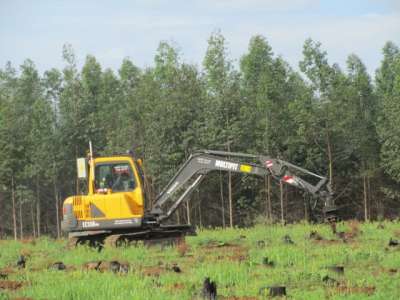

Over the years Global Positioning Systems and data acquisition equipment has been used successfully to help monitor the performance of forest machines. With the growth of technology engineers have developed custom data acquisition systems to collect performance data and machine location information. Having this knowledge helps in precision planning and implementation of forest operations (silviculture, and harvesting). In semi mechanised and mechanise silviculture operations GPS’ help optimise machine productivity, monitor asset health, track forest position, vehicle travel patterns and the number of vehicles passes to avoid excessive soil compaction.
How it works
A GPS can be mounted on a forest machine (e.g., tractor, pitting machine, planting machine etc.) and connected to the data acquisition system. With the location system input, computer hardware can collect information such as distance travelled, the machine status at each location and the productivity of the machine at each location. Purpose build machines performing silviculture or harvesting operations come with standard telematics. Silviculture machines can be monitored through telematics, machines come with T Maps incorporated as part of onboard software and through a web-based solutions for PC’s, tablets, and mobile phones. Contractors can in real time receive information about the progress of machine working on-site and can estimate the completion of the work, thus making it easier to keep direct contact to the work site through the message board. Furthermore, through telematics managers can monitor the machine via computerised application interfaces which give information such as fuel, oil, engine, operator performance level reports, transmits data via satellite and important performance and service information is provided in near real time. John Deere, Tigercat, Hexagon are some of the manufactures who uses the telematics systems.
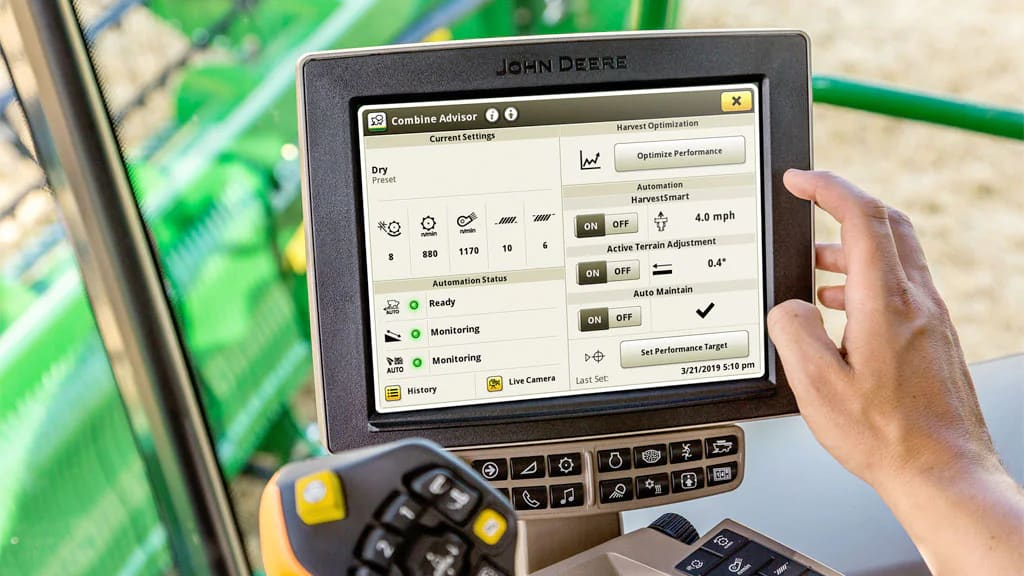
Source: John Deere
Benefits of GPS monitoring and tracking of vehicles
The use of telematic systems which incorporate geospatial technologies such as the global positioning system (GPS) and GIS improve operational efficiency and reduce the cost of planting and growing wood fibre in plantation forestry. In forestry tracking systems can be used on machines to further improve the efficiency of herbicide spraying or fertilizer application by evaluating the coverage to determine skipped or overlapped areas using GPS and variable-rate technology (VRT). Available control systems and field computers give real time guidance information to the machine operator to minimize areas of overspray and assisting operators with navigation during operations. These systems have the potential to improve guidance for forestry site preparation operations both pitting and herbicide or fertilizer application, moreover rows can be estimated more precisely to minimize erosion and to maximize the number of trees planted on the site.
This data collected can help forest managers and engineers in their post operation evaluation especially in terms of the machine velocity over time, the distances it travels between activities and any elevation changes it encounters that may affect its performance characteristics. A Dual Mode GPS tracking satellite device was developed by the Titan GPS, it uses Iridium satellite constellation to accurately monitor vehicles and equipment in remote locations when forestry equipment travels outside of the cellular network, the Titan GPS satellite tracking devices activate the Iridium satellite constellation and compensates for lack of cellular coverage.
Conclusion
Digital technology is revolutionizing industries around the globe. Agriculture is undergoing enormous change due to technologies like variable-rate fertilization and automated harvesting. Forestry has lagged in adopting digital technology but with the growth of technology the forestry industry is gradually adapting and using the technology. With the use of this technology forest management results have improved in the sense that managers can now accurately monitor their operations in real time. Moreover, as purpose build machines come with a standard on-board built software, communication between the operator and the manager is easier. Furthermore, reports about the machine’s health, status and functionality are readily available to the manager when required.